News
Visit our New Euro-American Figures Gallery!
Following two years of planning and phased upgrades, the Dallin Museum’s new Euro-American Gallery is now complete! We are tremendously grateful for the partnership and advocacy of Representative Sean Garballey, who helped to secure grant funds from the Commonwealth of Massachusetts to make this project a reality.
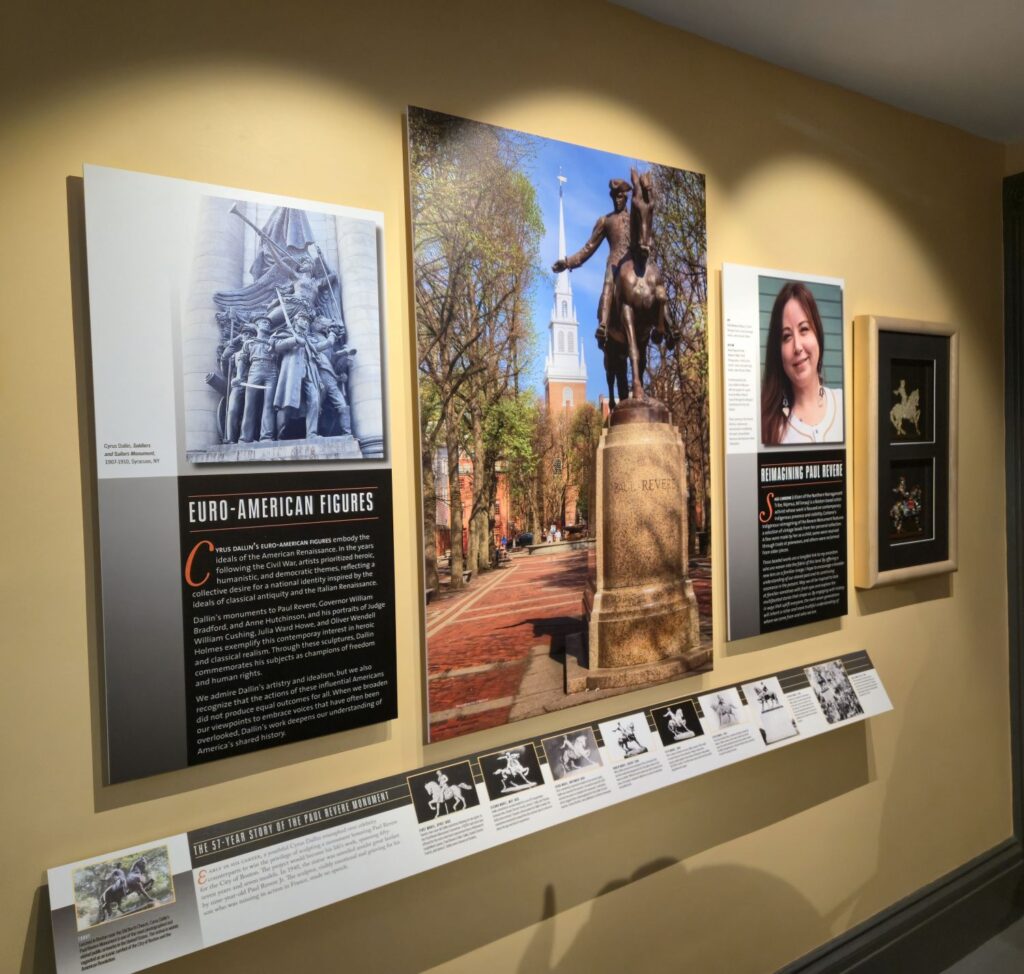
The new gallery places Dallin’s sculptures of Euro-American figures in the context of the American Renaissance, a period following the Civil War when art and design reflected a collective desire to shape a national identity inspired by the humanistic and civic ideals of classical antiquity and the Renaissance.
Dallin Museum Executive Director, Heather Leavell, explains that the exhibit also builds on the interpretive approach that was established in the Indigenous Peoples Gallery. “We view each of Dallin’s sculptures,” says Leavell, “as an opportunity explore the stories of historically underrepresented people whose ideas and actions shaped America’s shared history.”
Gallery Highlights:
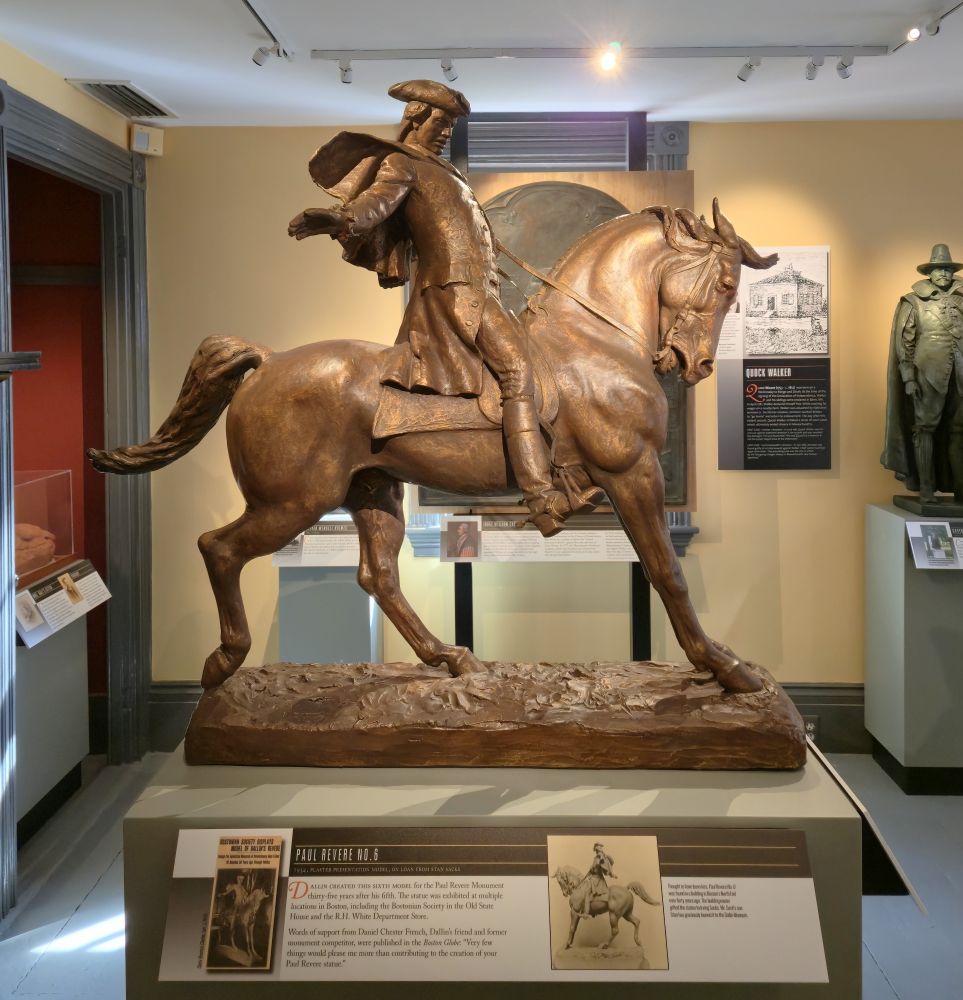
• View a rare master plaster of Dallin’s sixth prototype for the Paul Revere Monument, generously loaned to the Museum by Stan Sacks.
• Gain a richer, multifaceted understanding of the Paul Revere Monument through a new audio program featuring Dallin Museum founder James McGough reciting Cyrus Dallin’s parody of Longfellow’s Paul Revere’s Ride, an Indigenous beadwork reimagining of the statue by Sage Carbone (Northern Narragansett), and a Contemporary Perspective panel by historian Anthony Sammarco highlighting Dallin’s and Revere’s connection to the Massachusetts Charitable Mechanic Association.
• Deepen your knowledge of the history of slavery in Massachusetts through new interpretive displays written by public historian and storyteller Sean D. Osborne. Osborne provides vital historical context for Dallin’s Judge William Cushing plaque and shares the remarkable story of Quock Walker, a self-emancipated man whose case against his former enslaver was heard in Cushing’s court and ultimately ended slavery in the Commonwealth.
• Experience a new exhibit niche, transformed from a former closet, that highlights Dallin’s early years in Boston and showcases Panther of India No. 2, on display after many years in storage.
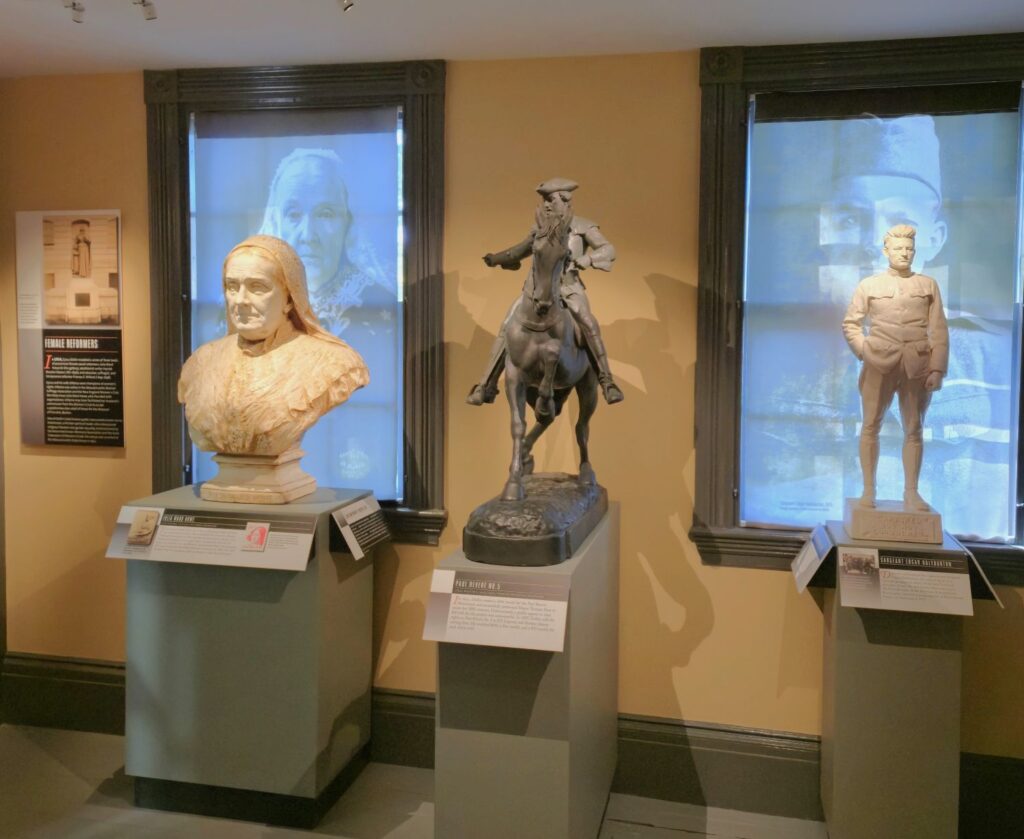
• Learn about Julia Ward Howe’s passionate activism on behalf of the Armenian people in the years leading up to the genocide through a Contemporary Perspective panel featuring insights from historian Peter Balakian.
• Discover the tragic story of World War I Prisoner of War Sargent Edgar Halyburton who was haunted by Dallin’s Captured But Not Conquered.
We are grateful to Chris Danemayer of Proun Design for his thoughtful work on the new gallery layout and design, and to Mystic Custom Fabrication for their production of new pedestals and interpretive components.
We hope the new gallery offers visitors fresh perspectives on Cyrus Dallin’s art and a deeper appreciation of the people and ideas that inspired his work. The Dallin Museum is open on weekends from 12-4. Reservations are not required. To schedule a time to visit outside of those hours, please contact Nancy Blanton at nblanton@dallin.org.
Visit Our New Indigenous Peoples Gallery!

On July 23, 2022, the Dallin Museum opened its new Indigenous Peoples Gallery. Cyrus Dallin’s sculptures of Indigenous peoples elicit important, and sometimes difficult, conversations about race and representation. In particular, his Appeal to the Great Spirit at the MFA, Boston has become a flashpoint for public dialogue around stereotypes, Indigenous erasure, and settler colonialism. The new Indigenous Peoples Gallery explores these important topics in a way that honors past and present Indigenous perspectives and encourages continued learning.
Museum Director and Curator Heather Leavell developed the gallery’s interpretive themes and text in close consultation with Elizabeth Solomon, Elder of the Massachusett Tribe at Ponkapoag and Forrest Cuch, Elder of the Ute Tribe and former Director of Indian Affairs for the State of Utah. Both Solomon and Cuch read all exhibit text for accuracy and sensitivity.
Thematic panels explore Dallin’s work in the context of his time, artistic intentions, and advocacy, with a focus on his close relationships with Indigenous people and his vehement public criticism of U.S. genocidal policies. Text rails accompanying sculptures highlight perspectives on Dallin’s art by his Indigenous contemporaries. The exhibit also centers the stories of such influential figures as Chief Washakie (Eastern Shoshone), Francis LaFlesche (Omaha), Zitkála -Šá (Yankton Dakota), and Sacajawea (Lemhi Shoshone).
Additional thematic panels explore contemporary Indigenous views on Dallin’s art, the evolving role of the ally, Native stereotypes, and the importance of Indigenous-centered education. Contributors include Faries Gray, Sagamore of the Massachusett Tribe at Ponkapoag; Claudia Tekina-ru Fox Tree, Arawak (Yurumein) educator, and Forrest Cuch.
Additional highlights include:
• An audio conversation between Cyrus Dallin (his words read by a voice actor) and Forrest Cuch that reveals a fascinating synchronicity in views on Ute culture, the history of violence against Indigenous peoples, and the need for the truthful telling of history. Listen to the recording here.

• A white board with the question, “How can non-Native people learn about issues that are important to Indigenous people?” Visitors are invited to write down their ideas.
• A “Whose Land Are you on?” panel written by Elizabeth Solomon that prompts visitors to contemplate their presence on Indigenous lands.
• A new, wall-length panel in the Museum’s entry illustrating Dallin’s art and legacy through quotes by the sculptor’s students at the Massachusetts Normal Art School, his friend Chief LeRoy Perry (Aquinnah Wampanoag), and Jonathan Fairbanks, Founder of the American Decorative Arts and Sculpture Department at the Museum of Fine Arts, Boston.
“This project represents the culmination of many years of research on Cyrus Dallin’s work as an ally and Indigenous rights advocate. It also reflects the Museum’s ongoing commitment to fostering dialogue on issues that are important to Indigenous people and impact all of us,” says Heather Leavell.
The Museum is grateful to the Massachusetts Office of Travel and Tourism and the Freedom’s Way National Heritage Area Partnership Grant Program for supporting this project. State funds were facilitated by Representative Sean Garballey, who worked with a team from the Museum that included the Chair of the Friends of the Dallin Museum, Stephen Gilligan, and President of the Board of Directors, Geri Tremblay.
Newsletters
Our August 2025 issue of News in High Relief is full of exciting updates, including the installation of Sage Carbone’s Paul Revere-inspired Indigenous beadwork, a $77,000 Community Preservation Act digitization grant, the acquisition of a bust of Cyrus Dallin by Moscow-based sculptor Andrey Sledkov, and our forthcoming Indigenous Little Free Library. Also, learn about our discovery of a photo of Dallin working on his Syracuse Soldiers and Sailors Monument and our new publication, Cyrus Dallin Art Museum: Highlights and Insights.
Past Issues:
News in High Relief, December 2024. Highlights: Unveiling of new “mini-Prado;” acquisition of Dallin’s longbow and quiver; progress on the digitization of Dallin’s personal archive; and remembrances of James McGough and Denice Dallin Wheeler.
News in High Relief, August 2024. Highlights: Completion of phase 1 of Euro-American Figures Gallery redesign; unveiling of Paul Revere No. 6 and Judge William Cushing; and reinstallation of the Angel Moroni statue on The Church of Jesus Christ of Latter-day Saints temple in Salt Lake City.